
Breaking News
Convicted Terrorist Kabiru Sokoto Challenges Life Sentence

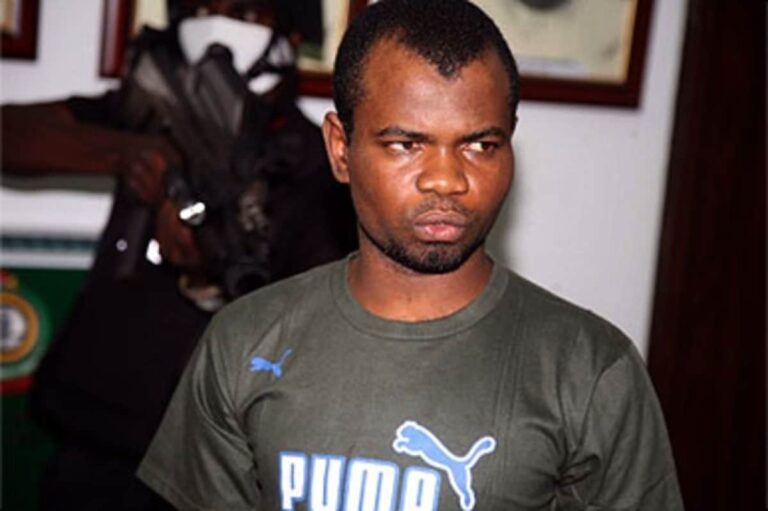
Convicted terrorist, Kabiru Umar, popularly known as Kabiru Sokoto, has approached the Court of Appeal in Abuja to challenge his 2013 conviction and life sentence over terrorism-related offences.
Fresh court documents showed that Umar, through his lawyers, Don Akaegbu & Company, filed a motion dated May 13, 2026, seeking an extension of time to appeal the judgment delivered by Justice A.F.A. Ademola of the Federal High Court, Abuja, on December 20, 2013.
Umar was sentenced to life imprisonment in 2013 over terrorism-related charges connected to the 2011 Christmas Day attack on St. Theresa Catholic Church, Madalla, Niger State. Reuters reported at the time that the attack killed 37 people and wounded 57 others.
The application was filed pursuant to Sections 6(6)(b) and 36 of the 1999 Constitution, Section 24 of the Court of Appeal Act and Orders 6 Rules 7 and 9 of the Court of Appeal Rules.
Umar is asking the appellate court for leave to file his notice of appeal out of time and for the notice already filed to be deemed properly filed and served.
He was convicted on a two-count charge bordering on alleged facilitation of terrorist acts and failure to disclose information relating to a terrorist incident.
In the motion on notice, Umar argued that the delay in filing the appeal was caused by circumstances beyond his control.
He cited prolonged incarceration, repeated transfers between custodial facilities in different states and the deaths of two lawyers earlier engaged to prosecute the appeal.
Part of the grounds filed before the court read, “The Applicant was convicted and sentenced to life imprisonment on 20th December, 2013. The Applicant has been continuously incarcerated since then.
“The Applicant was moved across several custodial centres across different States, making access to counsel extremely difficult. The Applicant’s trial counsel initiated steps toward appeal but died before perfecting same.”
The filing further stated that another lawyer later engaged by his family also died before taking concrete steps to prosecute the appeal.
In an affidavit deposed to by Umar’s nephew, Lawal Suleiman, the family said they only succeeded in locating the convict in March 2026 at the Maximum Security Custodial Facility, Kirikiri, Lagos.
Suleiman said repeated transfers weakened communication between Umar and his relatives in Sokoto State and worsened the family’s financial difficulties.
He also claimed that Umar’s health had deteriorated significantly during his years in custody.
The proposed notice of appeal also challenged the legal basis of the conviction.
Umar’s lawyers argued that the trial court wrongly relied on provisions of the Economic and Financial Crimes Commission Establishment Act, 2004, instead of the Terrorism (Prevention) Act, 2011.
The defence maintained that the EFCC Act was designed for financial and economic crimes and could not validly sustain a terrorism conviction.
The appellant also disputed the admissibility and voluntariness of his confessional statement marked Exhibit KUKS1, alleging that it was written by an investigating police officer in a question-and-answer format rather than freely narrated by him.
In a statement accompanying the court processes, Umar’s legal team insisted that he was not convicted for directly masterminding the Madalla church bombing.
According to the lawyers, the charge against him was limited to alleged possession of information relating to the bombing and failure to disclose it to authorities.
The statement read, “The distinction between direct participation and alleged prior knowledge is significant in law and forms a central issue in the pending appeal.”
BACKGROUND
Kabiru Sokoto came into national focus after the 2011 Christmas Day bombing of St. Theresa Catholic Church in Madalla, near Abuja. He was later charged in 2013, with Reuters reporting that Nigerian authorities accused him of masterminding the attack.
Channels Television also reported in December 2013 that the Federal High Court in Abuja sentenced him to life imprisonment over the Madalla bombing case.
Despite his incarceration, Umar was said to have obtained a Bachelor of Science degree in Biology from the National Open University of Nigeria.
He is asking the Court of Appeal to set aside the judgment of the Federal High Court, discharge and acquit him on all counts.
The application has been served on the Attorney-General of the Federation and Minister of Justice, but no date has been fixed for hearing.




FG Declares Tuesday Public Holiday

2027 Presidency: Tinubu Will Defeat Kwankwaso In Kano, Jibrin Boasts

Subsidy Removal: FG Discloses How ₦15.8 Trillion Savings Were Shared

Atiku Reveals How He Stopped Tinubu From Becoming His Running Mate

NDLEA Arrests Businessman With N23m Cocaine, Seizes N2.6bn Codeine

What Tinubu Said As INEC Declares Adeleke Winner of Osun Governorship Election

Osun Election Results: Davido Declares Adeleke Winner

Why Gov’t Has To Fund Mass Weddings In Sharia States With Public Money – Sheikh Gumi

State Police: Presidency Sets Today For Public Submissions Deadline

Osun Election: ADC Blames President Tinubu for Fadahunsi’s ‘Kill Accord Members’ Comment

Etisalat Offices in Lagos: Addresses and Contacts

Full List of Air Force Bases In Nigeria

Top 10 Richest Men in Anambra State

Full List of Airtel Stores and Office Addresses in Nigeria

Peace Mass Transit Price List, Terminals, Bookings, And Contacts

Full List of Political Parties In Nigeria and Their Slogan

Full List Of Pentecostal Churches In Nigeria

Uju Okoli Net Worth and Biography – Age, Family, Husband, and Career

Current Abuja Zip Codes: Full List of Abuja Postal Codes
