
Breaking News
PFIPC Controversy Shows Institutional Compromise, Says Ex-SGF Babachir Lawal

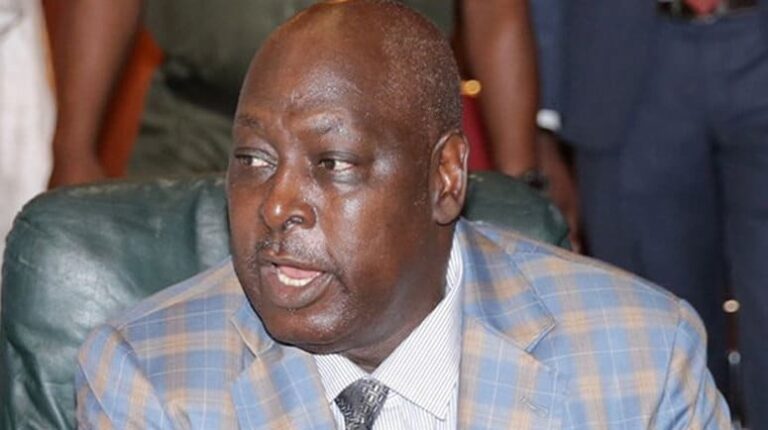
Former Secretary to the Government of the Federation, Babachir Lawal, has said the office of the SGF should have detected and stopped any correspondence from the alleged Presidential Foreign Investment Promotion Council, PFIPC, before it reached President Bola Tinubu.
Lawal spoke on Monday during an interview on Arise Television while reacting to the controversy surrounding the alleged PFIPC.
The Presidency had described the council as a fictitious organisation after allegations emerged linking its promoter, Adeniyi Adeyemi, to alleged bribery involving senior government officials.
Lawal said the verification procedures in the office of the SGF were designed to detect agencies without legal recognition.
“If an agency is received, processed, and forwarded without somebody asking in the SGF’s office exactly who these people are, it means there’s a dereliction of duty on the side of the SGF,” he said.
He explained that before appointments or approvals are processed, the SGF’s office ought to confirm whether the agency has legal backing.
“The act setting up that agency will sometimes say the position has to be advertised, interviewed, and shortlisted names sent to the president for approval.
“Some, you just write and he just approves. So, the SGF will go through the file and, in that process of due diligence, will be able to find out whether such an organisation exists. If there is no record for it in the SGF’s office, he will raise a red flag on it,” Lawal said.
The former SGF said federal agencies are created through a formal process involving presidential approval, consideration by the Federal Executive Council and, where necessary, legislation establishing their legal status.
“What we used to do is if there’s a new agency that either the president or a minister proposes to handle some specific assignments or duties, he will first of all raise a memo to the president, who will approve that such be created,” he said.
“And then a memo will be sent to the federal executive council on that particular agency, and we’ll debate it.”
According to him, any agency without proper documentation should not have passed through official channels.
Lawal also questioned how the alleged agency obtained a budget code and progressed through the federal budget process if it did not legally exist.
“It’s institutional compromise, because in this, I sense there’s quite a big racket going on somewhere along the line,” he said.
“If the agency was created by maybe one big man alone and then he wants to go through the budget process, the budget office assigns the budget code according to the chart of accounts in GIFMIS.
“So, how did they manage to assign the budget code for this agency that does not exist? Who inserted it?” he asked.
He said every ministry, department and agency is expected to defend its budget before the Budget Office of the Federation.
“Now, if you don’t exist, how did they recognise that you are a genuine entity? Who gave out the budget code and allowed their budget to pass?” Lawal queried.
Lawal said the office of the SGF should have identified any irregularity before the proposal reached the National Assembly.
“That’s what oversight is. The SGF should be able to know, because before it gets to the National Assembly, that budget goes through the SGF,” he said.
“Unless there’s a dereliction of duty by the SGF’s office, the responsibility to flag that this is a fake agency would have come from them.”
The former SGF called for a judicial inquiry into the matter, saying an internal administrative process would not be enough.
“I don’t think it should even be administrative alone; it should be a judicial inquiry,” he said.
Lawal also questioned Adeyemi’s claim that the alleged agency received a ₦27.5bn take-off grant before any budgetary allocation.
“Nigerians are talking about how ₦1.3bn was inserted into the budget. The man himself first said the quarrel came about because he refused to part with 48 percent of the 27-point-something billion Naira take-off grant,” Lawal said.
“That money has been spent before this budget office was looking for the budget. Who gave him the money? It was not appropriated. It’s not in any budget.”
He said the reported release of the funds, if true, raised more serious questions than the alleged budget allocation.
“We are just talking about the tip of the iceberg here. Down there, before we got to here, ₦27.5bn had already been disbursed, according to him, as a take-off grant. How did that money get to him?” he asked.
The former SGF rejected suggestions that existing government safeguards exposed the alleged fraud.
“I think we all know that thieves and armed robbers always fight, and they expose themselves during sharing,” he said.
“So, it didn’t work. It should have worked before that money left the government coffers into the account of the agency.”
He said asking senior officials linked to the controversy to step aside during investigations would reflect established practice.
“I can use myself as an example. When there was this brouhaha between me and the Senate, remember I was suspended for some time while an investigation was going on. So now, that is best practice,” he said.
Lawal also faulted the National Assembly, accusing lawmakers of failing to properly scrutinise the budget.
“It is a legislative oversight. This National Assembly has no interest in scrutinising the budget that comes before them,” he said.
“Most of the legislators just go in there to earn their salaries and collect allowances and go. They don’t scrutinise the budget line by line.”
Lawal alleged that the current administration had weak institutional controls, adding that the controversy reflected deeper governance failures.
“This government doesn’t take governance seriously. When things like this happen, Nigerians are not surprised. It’s so porous,” he said.
He said attention should focus on those who enabled the alleged agency to function.
“Why are you interested in ₦27.5bn that had already been collected and spent?” he asked.
“We are talking about an agency that we are claiming doesn’t exist. Maybe it exists, but it doesn’t have a legal framework for its existence. But it exists.
“And there are a lot of powerful people that make sure it exists in that form. Those are the people we need to expose,” Lawal added.


FG Declares Tuesday Public Holiday

2027 Presidency: Tinubu Will Defeat Kwankwaso In Kano, Jibrin Boasts

Subsidy Removal: FG Discloses How ₦15.8 Trillion Savings Were Shared

Atiku Reveals How He Stopped Tinubu From Becoming His Running Mate

NDLEA Arrests Businessman With N23m Cocaine, Seizes N2.6bn Codeine

What Tinubu Said As INEC Declares Adeleke Winner of Osun Governorship Election

Osun Election Results: Davido Declares Adeleke Winner

Why Gov’t Has To Fund Mass Weddings In Sharia States With Public Money – Sheikh Gumi

State Police: Presidency Sets Today For Public Submissions Deadline

Osun Election: ADC Blames President Tinubu for Fadahunsi’s ‘Kill Accord Members’ Comment

Etisalat Offices in Lagos: Addresses and Contacts

Full List of Air Force Bases In Nigeria

Top 10 Richest Men in Anambra State

Full List of Airtel Stores and Office Addresses in Nigeria

Peace Mass Transit Price List, Terminals, Bookings, And Contacts

Full List of Political Parties In Nigeria and Their Slogan

Full List Of Pentecostal Churches In Nigeria

Uju Okoli Net Worth and Biography – Age, Family, Husband, and Career

Current Abuja Zip Codes: Full List of Abuja Postal Codes
