
Education & School Updates
Tinubu Govt More Focused on 2027 Than Insecurity – Says Dalung

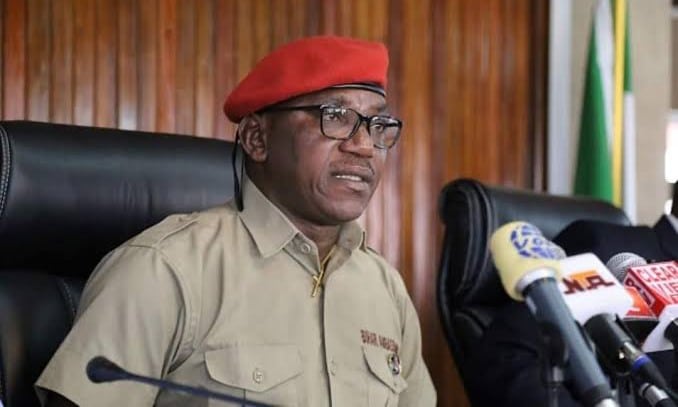
Former Minister of Sports, Solomon Dalung, has accused the Federal Government of lacking the political will to confront the worsening insecurity in the country.
Dalung, who served as minister under the late President Muhammadu Buhari, alleged that President Bola Tinubu’s administration appeared more concerned about the 2027 general elections than the lives of Nigerians being lost to killings, abductions and terrorist attacks.
The former minister made the claim on Friday while speaking on Arise Television’s Morning Show, where he criticised the administration’s handling of security, the economy and governance.
According to him, the government has the capacity to track critics and political opponents but has failed to deploy the same level of seriousness in tracking terrorists operating from forests.
“Government seems not to have the political will to deal with it. They have all the gadgets to track anybody who criticises the government — they can pick him up in the next five minutes. But they don’t have equipment to track terrorists who display huge phones in the forest, behead teachers, abduct schoolchildren, torture them in the forest, produce videos and send,” Dalung said.
Dalung also faulted the recent appeal by the Minister of Information urging Nigerians to unite against terrorism, describing the statement as “uncalled for,” “an embarrassment,” and “demoralising.”
He said the appeal showed that the Federal Government had run out of ideas on how to tackle the security crisis.
“I think it’s a statement confirming that the federal government has completely and woefully failed. They don’t seem to have any idea of a solution to the ravaging insecurity that is across the country,” he said.
The former minister argued that the two major problems affecting the fight against insecurity were the absence of political will and poor coordination among security agencies.
He said the intelligence community, the military and other security agencies were not working together as a united force.
According to him, the agencies appear to be operating in isolation, with each struggling for access to the President instead of sharing intelligence and building a coordinated response to terrorism.
Dalung warned that terrorist groups had become so emboldened that they now appeared to be running what he described as a parallel economy in the forests.
He also questioned the impact of reported American military support in Nigeria, saying Nigerians had yet to feel the effect of such assistance.
“We were told that the Americans are here with us. If the Americans are here with us, what have they been doing? We have not felt their impact,” he said.
He urged the government to stop issuing repeated assurances and begin to empower local communities to take greater responsibility for their own security.
‘NIGERIA RETURNING TO FIRST REPUBLIC POLITICS’
Speaking on the build-up to the 2027 elections, Dalung expressed concern over what he described as a dangerous return to regional politics.
He said Nigeria appeared to be moving back to the political structure of the First Republic, where regions had strong political identities and parties.
“Nigeria has returned to the politics of the first republic, where regions now have their political parties. Almost all the zones have presidential candidates. So ultimately, in 2027, we may be facing serious confusion as we advance towards election,” he said.
Dalung added that the North-Central geopolitical zone would again become a major battleground in the next presidential election.
He accused the political class of focusing more on election calculations than on governance and the welfare of citizens.
Assessing Tinubu’s three years in office, Dalung said the President had failed to meet the expectations of many Nigerians who believed his experience as a former Lagos State governor would translate into effective national leadership.
He said the administration had continued to speak about reforms without showing clear benefits for ordinary citizens.
“Three years into his tenure, it is just blame game and rhetorics of reforms — reforms that no single iota of the benefit has trickled down. Rather, Nigerians are getting impoverished daily. The economy is in doldrums. Insecurity remains rhetorical,” Dalung said.
The former minister said Nigerians had become poorer under the administration, while insecurity had remained a major threat in many parts of the country.
However, a political scientist, Obafemi George, who also appeared on the programme, disagreed with Dalung’s assessment.
George argued that the Tinubu administration deserved more credit for taking difficult decisions which, according to him, were necessary to stabilise the economy and lay the foundation for long-term growth.
He cited Nigeria’s sovereign credit rating upgrade by Standard and Poor’s from B- to B as evidence that the economy was beginning to respond to the government’s reforms.
George also argued that the current wave of insecurity could not be blamed solely on the Tinubu administration, saying the withdrawal of French military forces from parts of the Sahel created a vacuum that terrorist groups exploited.
“This current administration has confronted insecurity that is higher than the previous administration, spent more, and recorded more successes in combating insecurity,” George said.
He pointed to rescue operations carried out in May in areas including Gwoza and Katsina as evidence that the security agencies had recorded some gains under the present government.
‘TINUBU HAS TICKED THE BOXES’
George said Nigerians should assess the President using clear performance indicators, including the economy, infrastructure, education, health and security.
“You know, when you employ someone, you give the person KPIs. And likewise, when you vote a president into office, there are certain KPIs, economy, infrastructure, education, health sector, even security. And if you look at each of those, in my opinion, I could confidently say that the president ticked the boxes,” he said.
He said nation-building required time and sacrifice, adding that no country had moved from poverty to prosperity within 36 months.
“I ask people to give me one example of a country in a modern era that has transitioned from being a poor country to a prosperous country in 36 months.
“China lifted a million people out of poverty, but they didn’t do it in 36 months. It took them 40 odd long years,” he said.
George argued that Tinubu’s focus on infrastructure and economic reforms was similar to the model adopted by countries that later achieved major growth.
He added, “When China started that job in 1979, their GDP was just partly $179 billion. They began to invest in infrastructure, which is what this government is doing.”
When asked whether Tinubu should remain in office for 40 years, George said his argument was that Nigerians should be realistic about the time required to rebuild a country.
“What I’m saying is that we should be realistic. Even God Almighty that personally took a nation out of Egypt and took them to the promised land, it took God 40 years and it was God personally leading them,” he said.
He also referenced Rwanda and Dubai, saying both places took decades of consistent planning to reach their current levels of development.
“When President Tinubu went to Rwanda, people started comparing, saying small Rwanda had done so much. I responded and said Kagame has spent over 20 years to take Rwanda to where they are today,” George said.
He added, “Dubai that we all go to today, they started that journey in 1974. It wasn’t until 2014 that Dubai actually arrived on the global scene as a tourist powerhouse. President Tinubu has laid a solid foundation.”
George said the hardship currently facing Nigerians was partly the result of past administrations failing to make difficult economic decisions early enough.
He specifically mentioned fuel subsidy removal, saying Nigeria would not have been in its present situation if subsidy had been removed years earlier.
“By 2014, the coordinating minister, Dr Ngozi Okonjo-Iweala said that Nigeria was broke, that we should stop paying subsidy. If we had removed subsidy 10-12 years ago, we won’t be where we are today,” he said.
According to him, the decisions being taken by the Tinubu administration are meant to prevent the country from facing the same economic crisis in the future.
“And the decision that President Tinubu has made today is so that in 10 years’ time, we will not sit down like this and be discussing this plan again,” George added.





Keyamo Speaks On Peter Obi’s Benue Visit, Accuses Media Of Bias

Tinubu Gets Nigerians’ Reactions Before Policy Changes – Information Minister Idris Reveals

2027 Election: Umeh Backs Peter Obi, Warns Against Vote Manipulation

Nigerian Youths Selling Their Kidneys Due To Hardship Under Tinubu Gov’t – Atiku

PFIPC: Court Denies Bail To ‘Fake DG’ Adeyemi, Orders Police To Grant Him Access To Lawyers

They Will Come For My Head If Tinubu Loses 2027 Election – Wike

2027: ‘Our Back Is Against The Wall’ – Opposition Parties Begin Fresh Plot To Defeat Tinubu
Pray For Us, We’re Nigeria’s Problem – Peter Obi Tells Nigerians

US To Withdraw 200 Troops From Nigeria After ISIS Commander’s Killing

‘Police Are The Unknown Gunmen, I’ll Tender Evidence’ – VeryDarkMan Alleges

Etisalat Offices in Lagos: Addresses and Contacts

Full List of Air Force Bases In Nigeria

Top 10 Richest Men in Anambra State

Full List of Airtel Stores and Office Addresses in Nigeria

Peace Mass Transit Price List, Terminals, Bookings, And Contacts

Full List of Political Parties In Nigeria and Their Slogan

Full List Of Pentecostal Churches In Nigeria

Uju Okoli Net Worth and Biography – Age, Family, Husband, and Career

Remita Customer Care and Contact Details (Updated)
